DiffCom: Decoupled Sparse Priors Guided Diffusion Compression for Point Clouds
The University of Western Australia, Xidian University
DiffCom is a decoupled sparse-prior guided diffusion framework for point cloud compression, designed to reduce latent redundancy while preserving high-fidelity geometry under aggressive bitrates.
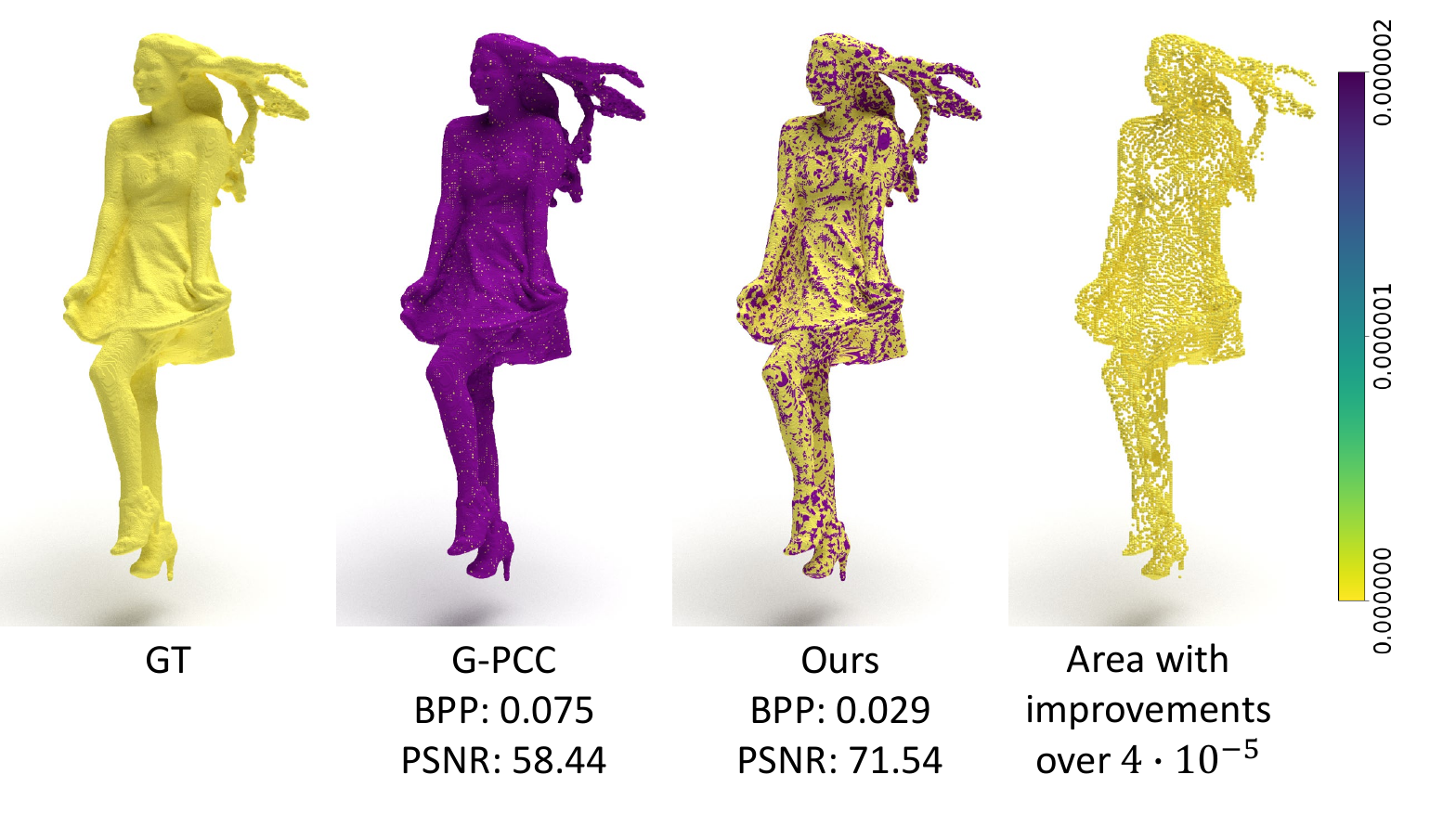
Abstract
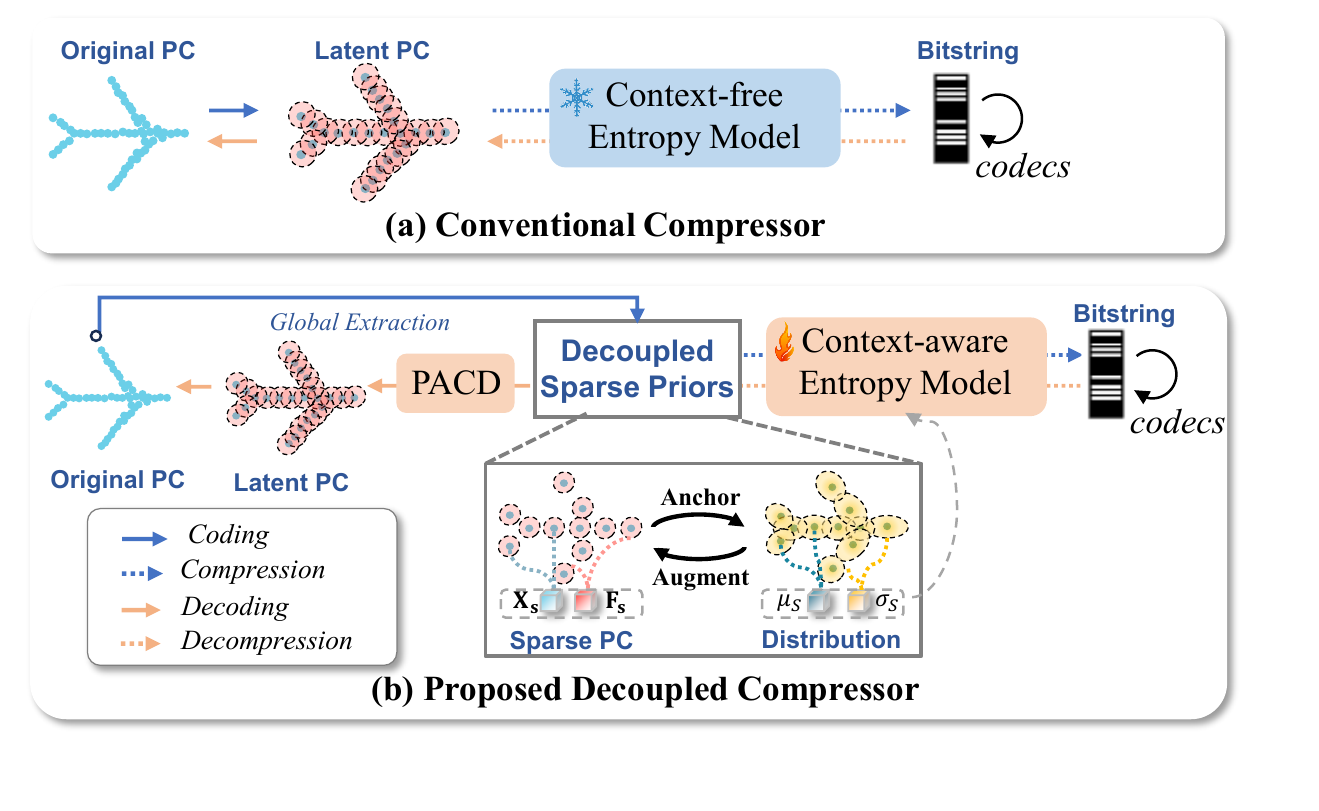
While conventional lossy compression methods predominantly depend on autoencoders to map point clouds into latent representations, they often neglect the intrinsic redundancy within these latent points. To address this limitation, DiffCom presents a diffusion-based architecture steered by sparse priors, designed to minimize latent redundancy while securing superior reconstruction fidelity, particularly in low-bitrate scenarios.
A key feature of the framework is an efficient dual-density data flow that alleviates the stringent size constraints imposed on latent points. By integrating a Probabilistic Attention-based Conditional Denoiser (PACD), the method encapsulates critical reconstruction details within sparse priors, which are hierarchically decoupled into intra- and inter-point components. Comprehensive experiments on ShapeNet and standard MPEG PCC datasets demonstrate superior rate-distortion trade-offs.
Pipeline
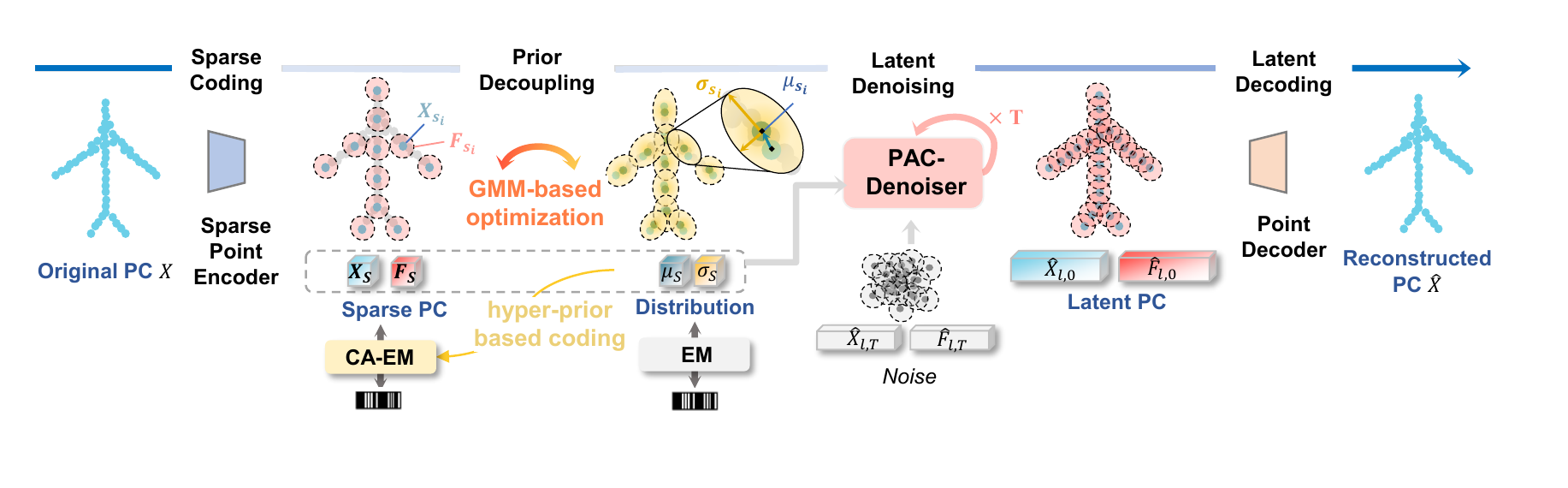
The pipeline employs a two-stage data flow. First, DiffCom extracts sparse priors through a sparse point encoder and context-aware entropy model. Then, during decompression, it starts from Gaussian noise and applies PACD conditioned on the sparse priors to reconstruct dense latent representations, which are decoded into the final point cloud.
Qualitative Results
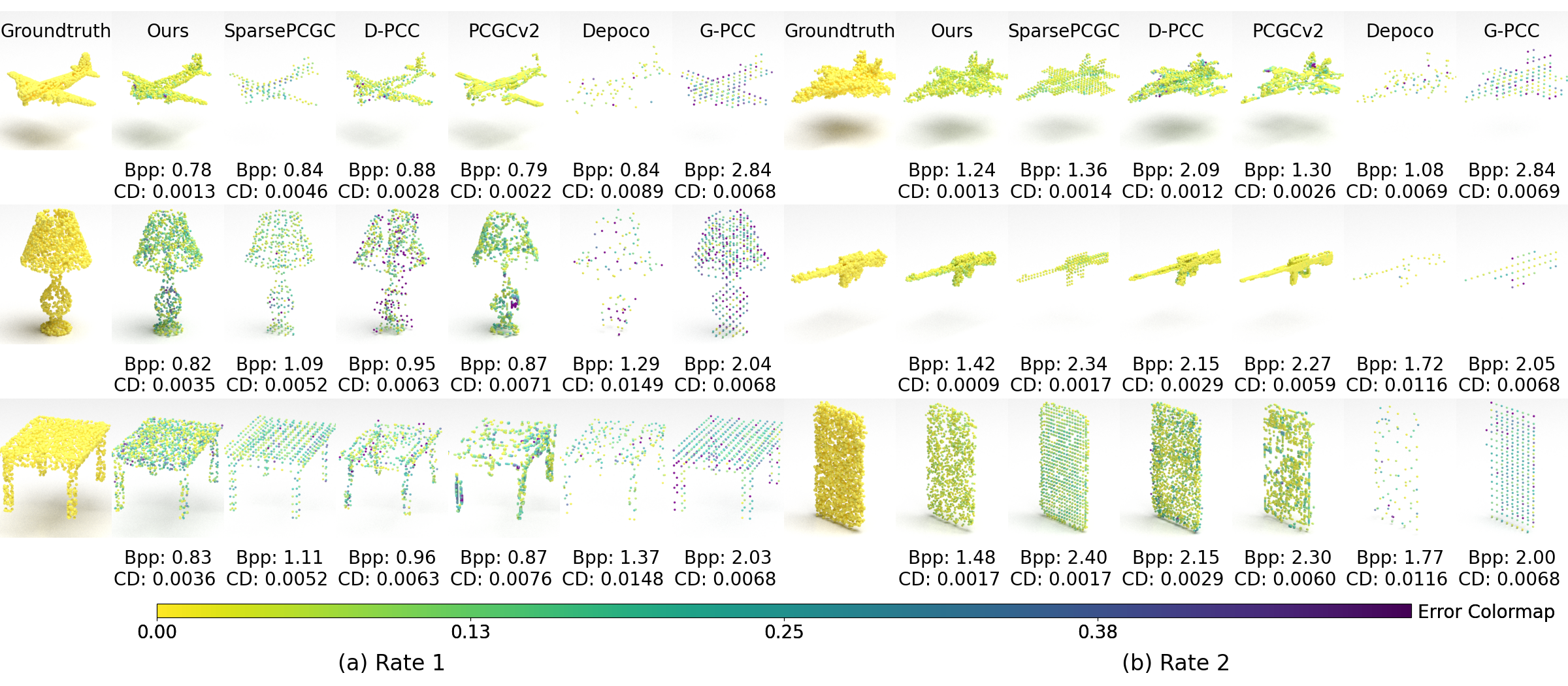
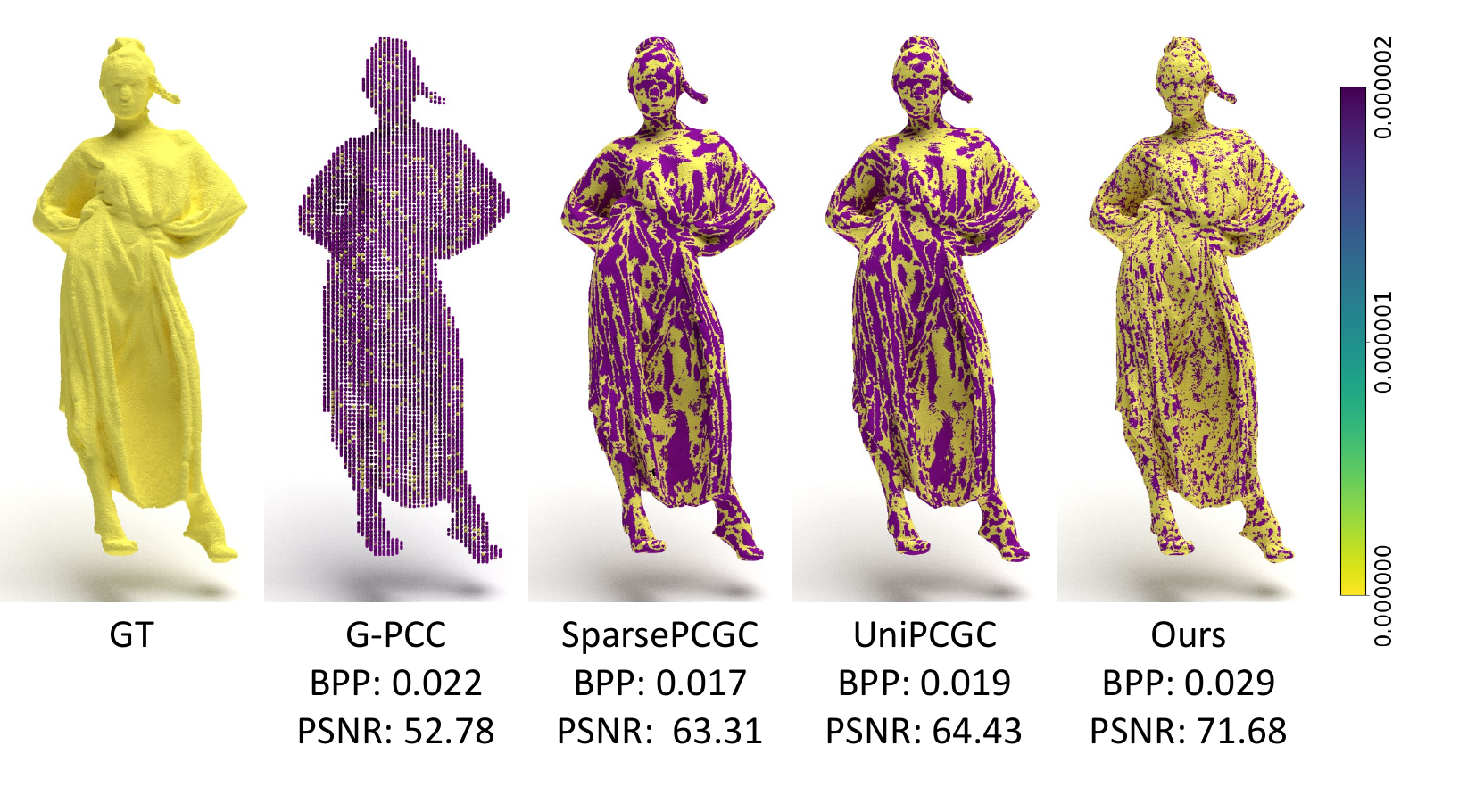
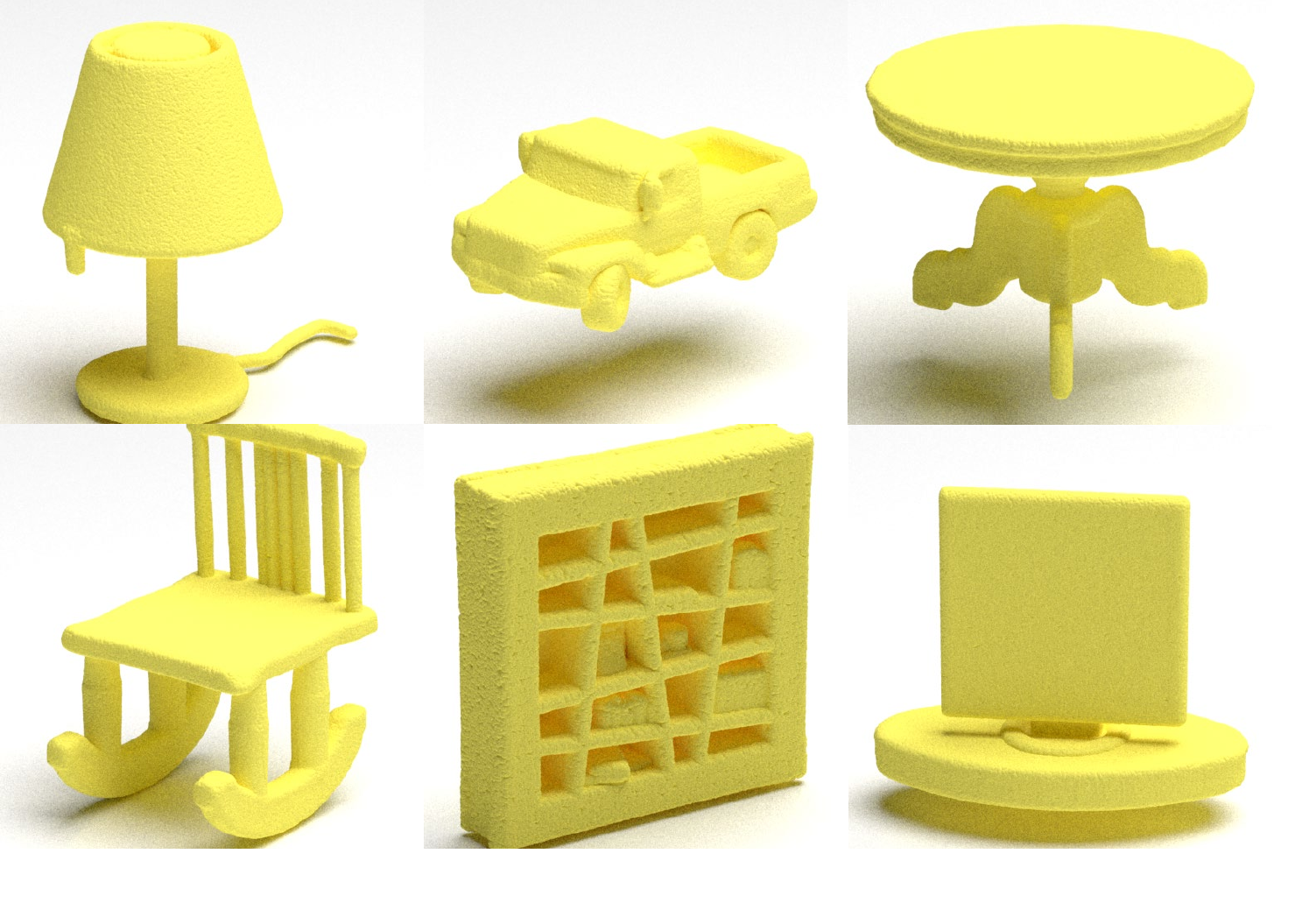
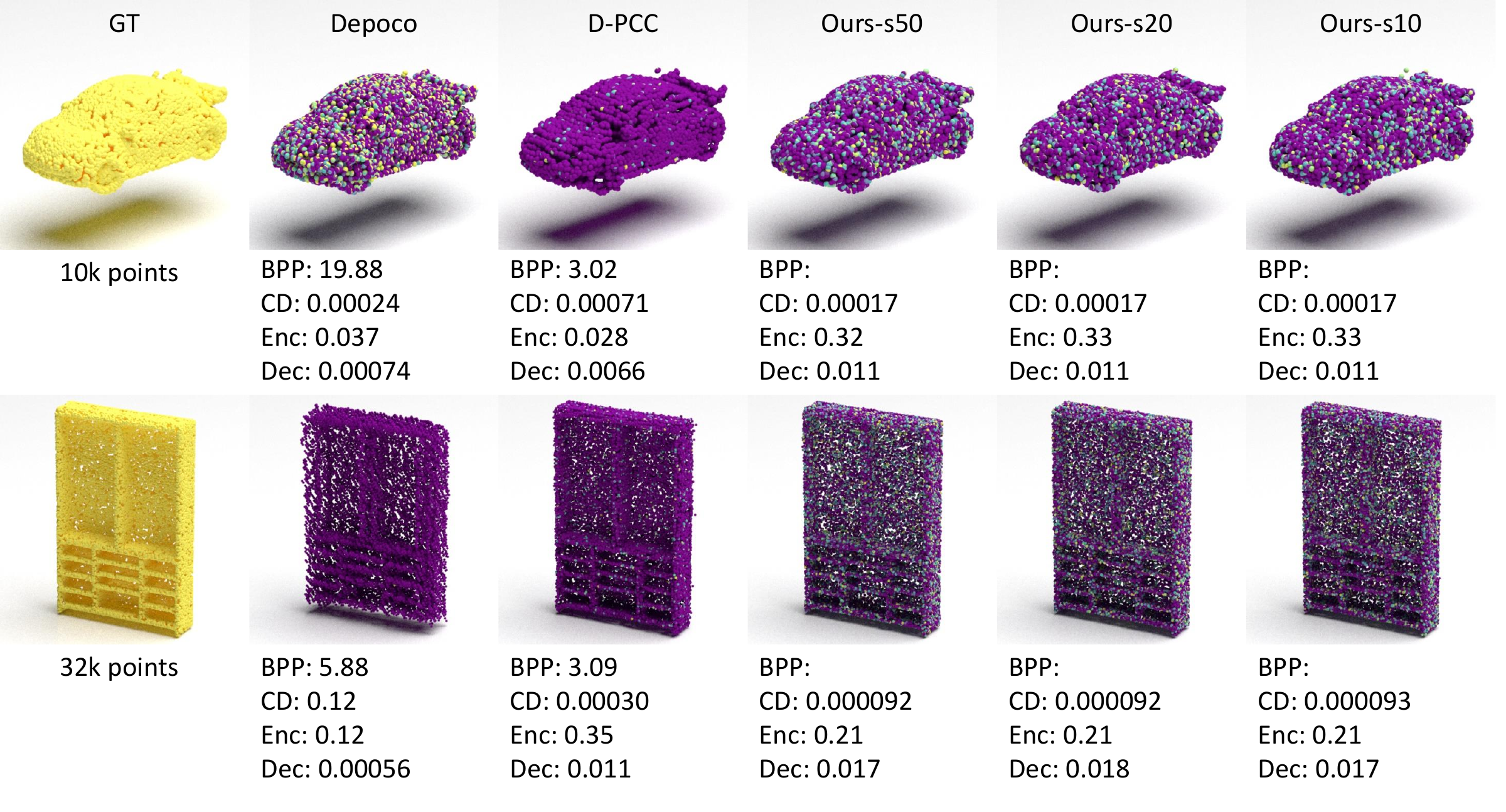
DiffCom preserves more complete object structures at matched bitrates on ShapeNet and generalizes to dense MPEG point clouds.
Datasets
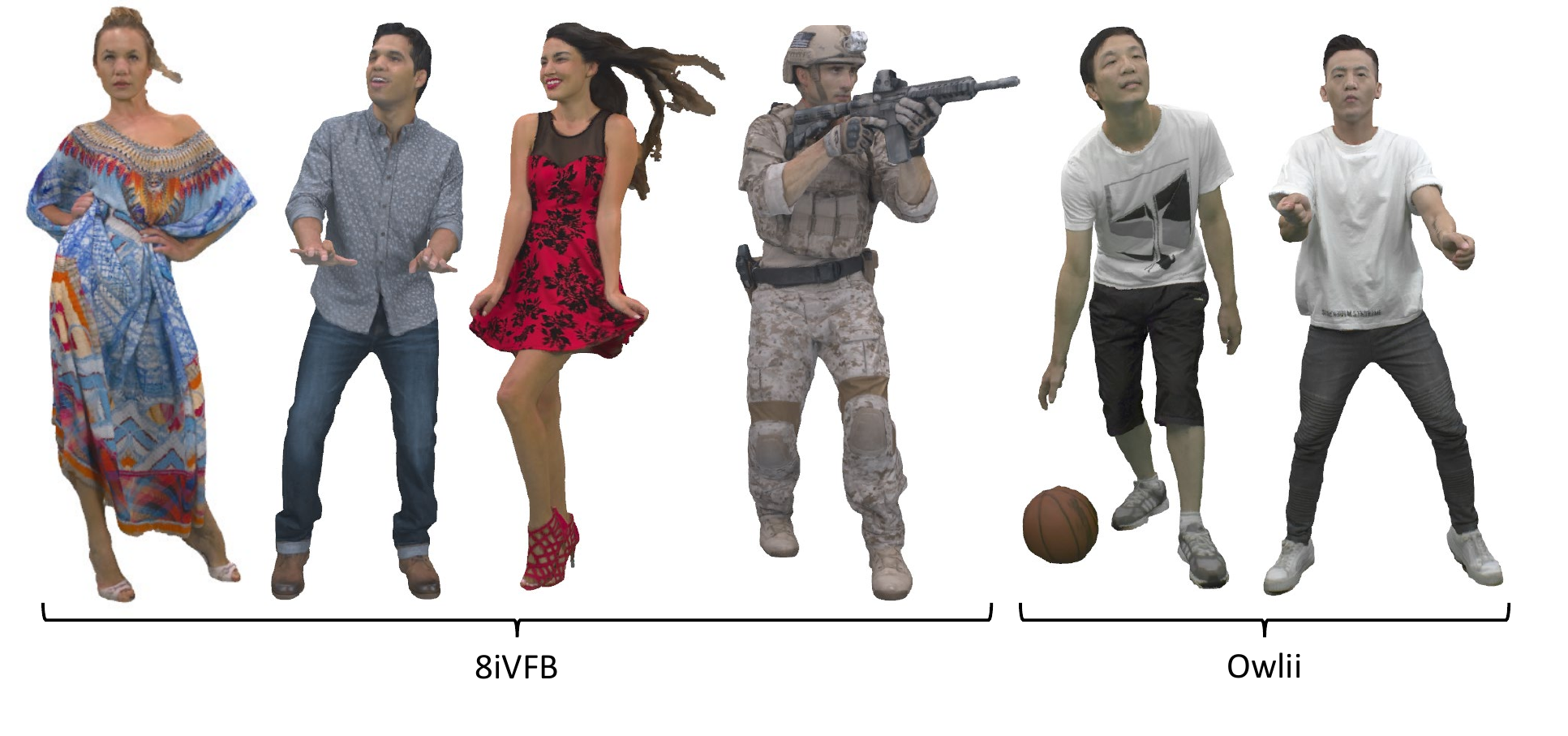
DiffCom is trained on ShapeNet and evaluated on object-level ShapeNet point clouds as well as standard MPEG PCC test samples from 8iVFB and Owlii.
Rate-Distortion Results
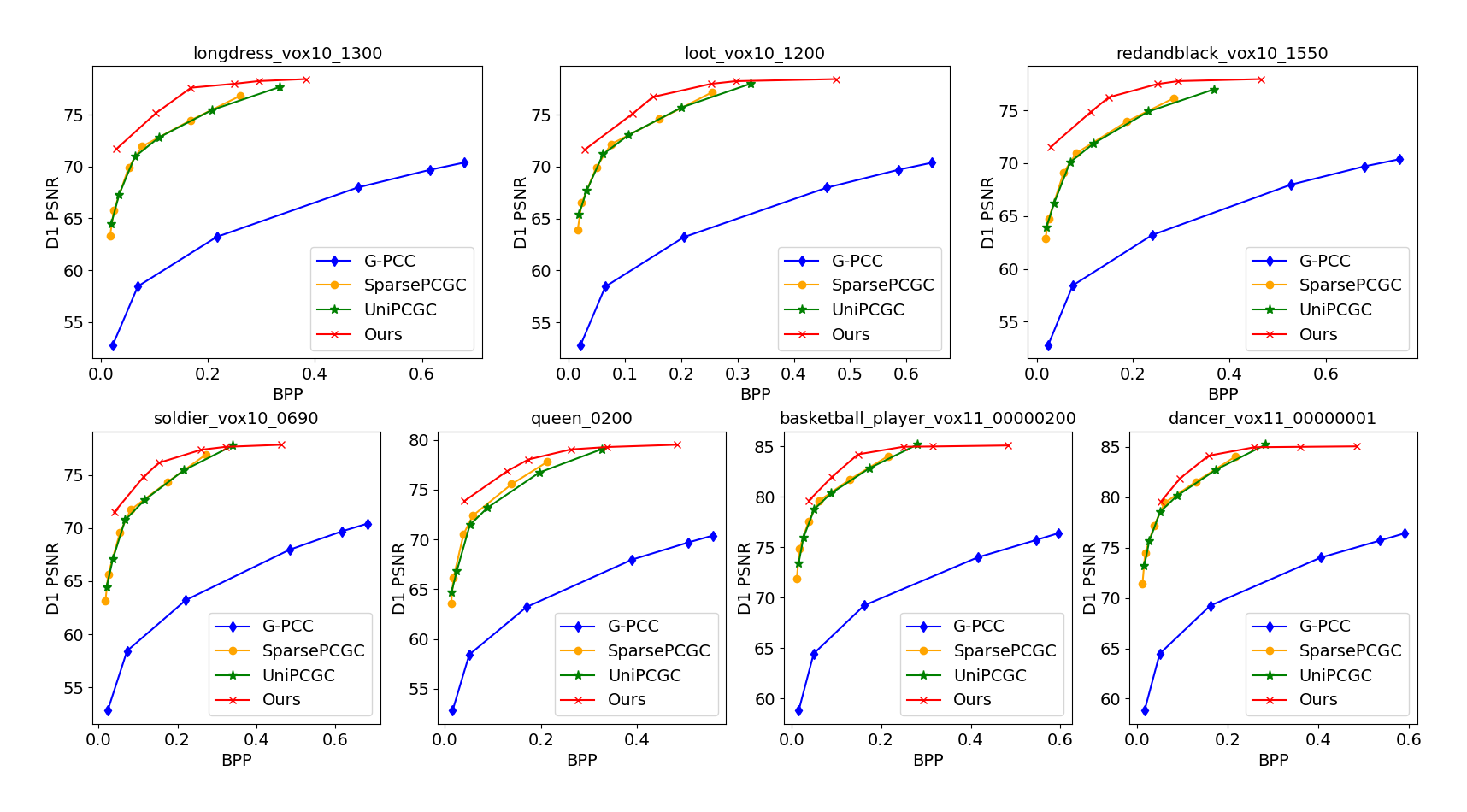
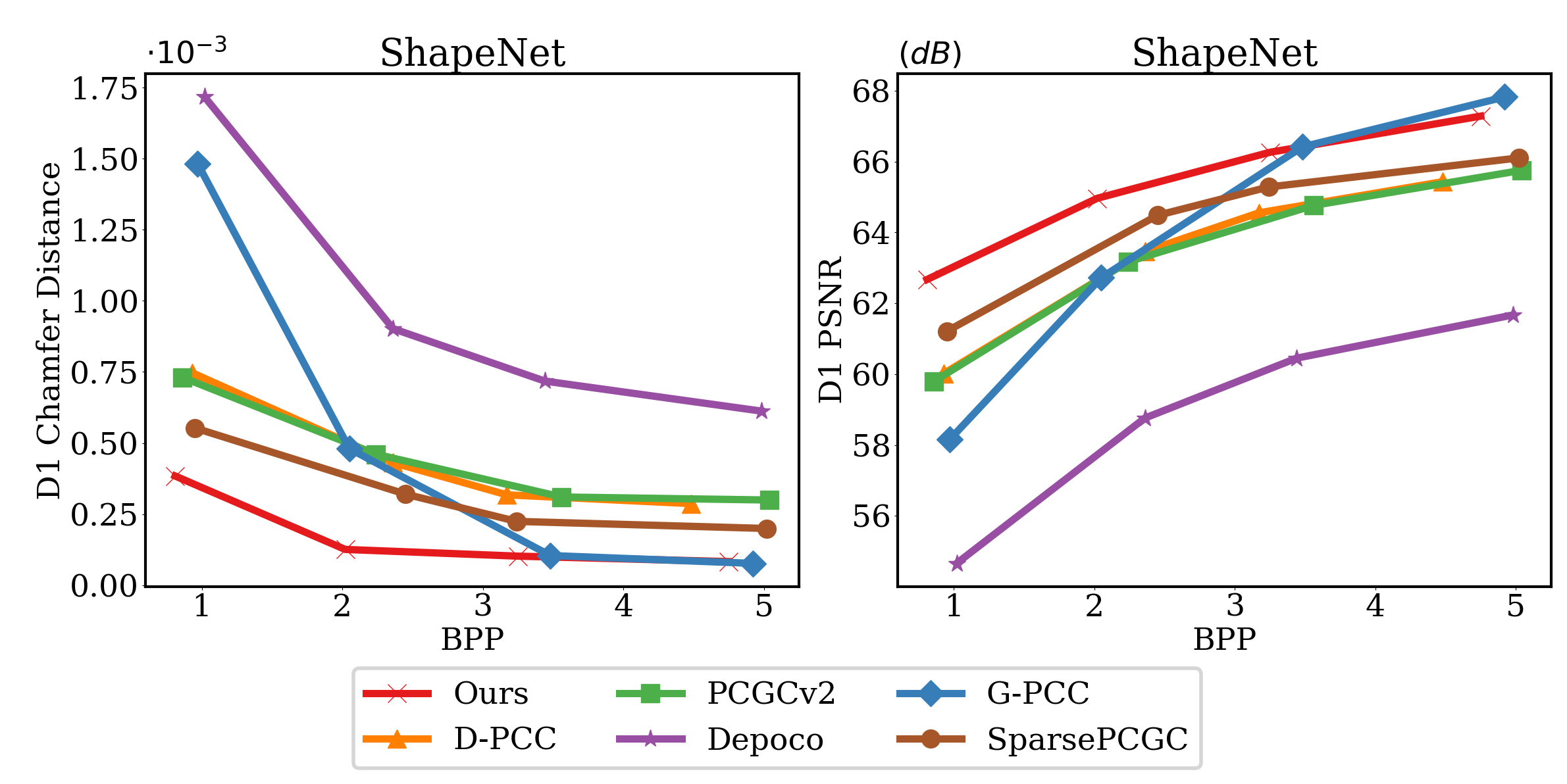
| Dataset | PSNR Gain | Rate Saving |
|---|---|---|
| MPEG average vs. G-PCC | +14.62 dB | 98.46% |
| ShapeNet vs. Depoco | +6.89 dB | 89.31% |
Code
Code will be released when available.
Citation
@article{zhang2026diffcom,
  title={DiffCom: Decoupled Sparse Priors Guided Diffusion Compression for Point Clouds},
  author={Zhang, Xiaoge and Wu, Zijie and Feng, Mingtao and Nasim, Mehwish and Anwar, Saeed and Mian, Ajmal},
  journal={IEEE Transactions on Circuits and Systems for Video Technology},
  year={2026},
  publisher={IEEE}
}