FLaTEC: Frequency-disentangled Latent Triplanes for Efficient Compression of LiDAR Point Clouds
ICME 2026
- Xiaoge Zhang1
- Zijie Wu1
- Mingtao Feng2
- Zichen Geng1
- Mehwish Nasim1
- Saeed Anwar1
- Ajmal Mian1
- 1The University of Western Australia
- 2Xidian University
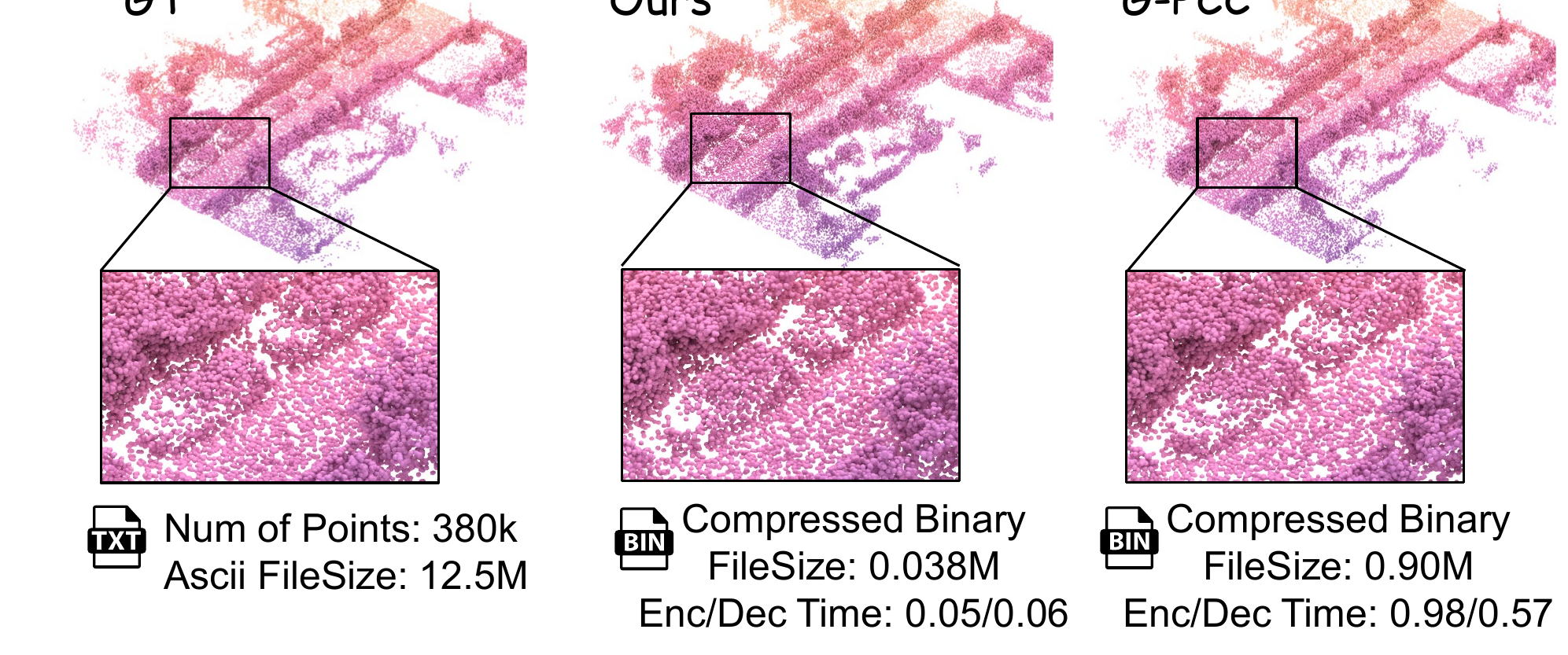
Qualitative and quantitative comparison of point cloud compression methods. The proposed FLaTEC substantially reduces both the compressed file size and encoding/decoding time, while achieving comparable reconstruction quality to the baseline. The zoom-in region highlights on-road vehicles in the autonomous driving context.
Abstract
Point cloud compression methods jointly optimize bitrates and reconstruction distortion. However, balancing compression ratio and reconstruction quality is difficult because low-frequency and high-frequency components contribute differently at the same resolution. To address this, we propose FLaTEC, a frequency-aware compression model that enables high compression of a full scan. We first convert voxelized embeddings into triplane representations to reduce sparsity and storage requirements, and then introduce a frequency-disentangling technique that isolates compact low-frequency components while aggregating multi-scale high-frequency details. The decoupled low-frequency and high-frequency components are stored in binary format. During decoding, full-spectrum signals are progressively recovered via a modulation block. Our method achieves state-of-the-art rate-distortion performance and outperforms the standard codecs by 78% and 94% in BD-rate on both SemanticKITTI and Ford datasets.
Key Idea: Anisotropic Bitrate Allocation
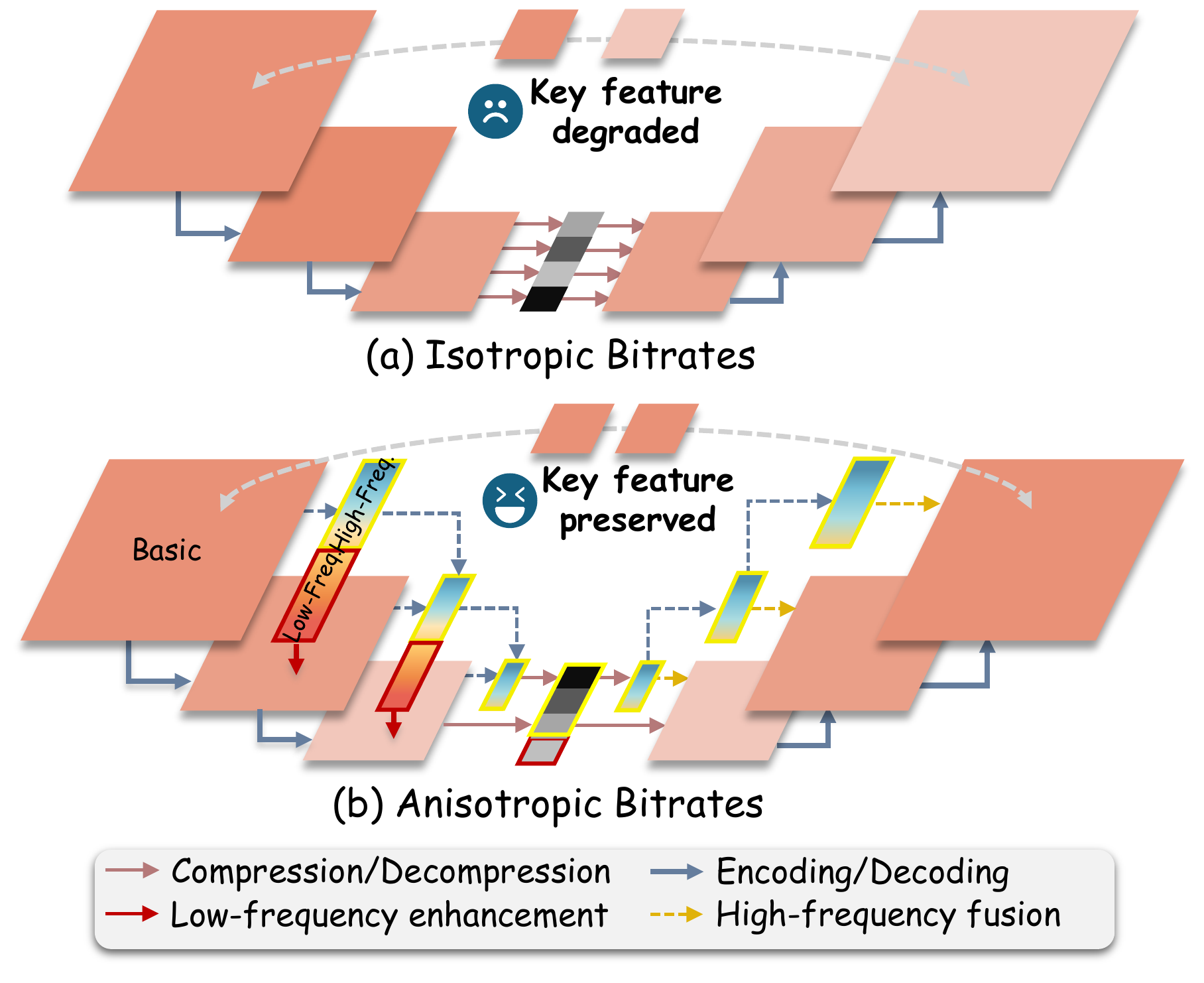
(a) Traditional deep learning methods encode all frequency components at the same resolution, resulting in a suboptimal trade-off for compression. (b) Our method disentangles high-frequency details from basic features, allowing for flexible bitrate allocation across different levels of detail.
Pipeline
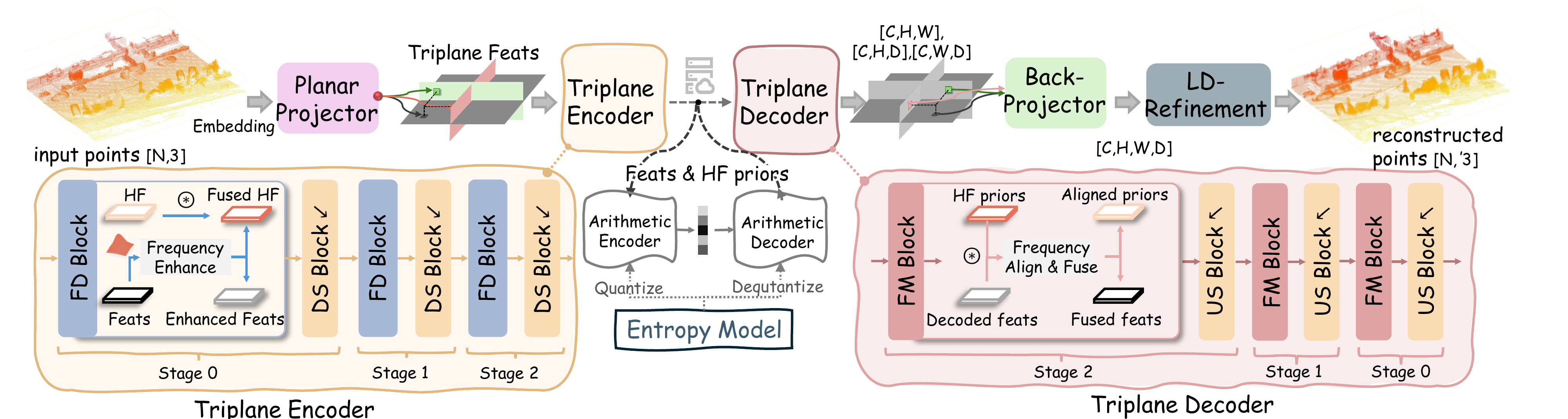
Overview of our compression method. FD and FM refer to feature decomposition and frequency modulation. HF is high frequency. Voxel features are initially projected onto three orthogonal views—top, front, and side—to reduce sparsity and storage costs. These projected triplane features are then processed through separate 2D encoders, which output global content and high-frequency priors. The encoded features are subsequently quantized and converted into a binary string. During decoding, 2D decoders reconstruct fine-grained triplane features guided by high-frequency priors. Finally, the voxel features are refined with spatial correlations before generating volumetric occupancy probability.
Results
Runtime and Rate-Performance on 40mILEN
| Method | Enc/Dec (s) | Rate Gain | PSNR Gain |
|---|---|---|---|
| G-PCC | 2.25/1.43 | 0.00% | 0.00 |
| Depoco | 0.17/0.00086 | +54.04% | -2.06 |
| D-PCC | 1.26/0.24 | +89.70% | -0.46 |
| Pointsoup | 2.58/0.0045 | -64.11% | +3.40 |
| Ours (w/o R) | 0.065/0.12 | -94.21% | +1.40 |
| Ours | 0.065/0.19 | -93.73% | +1.89 |
Rate-Distortion on SemanticKITTI
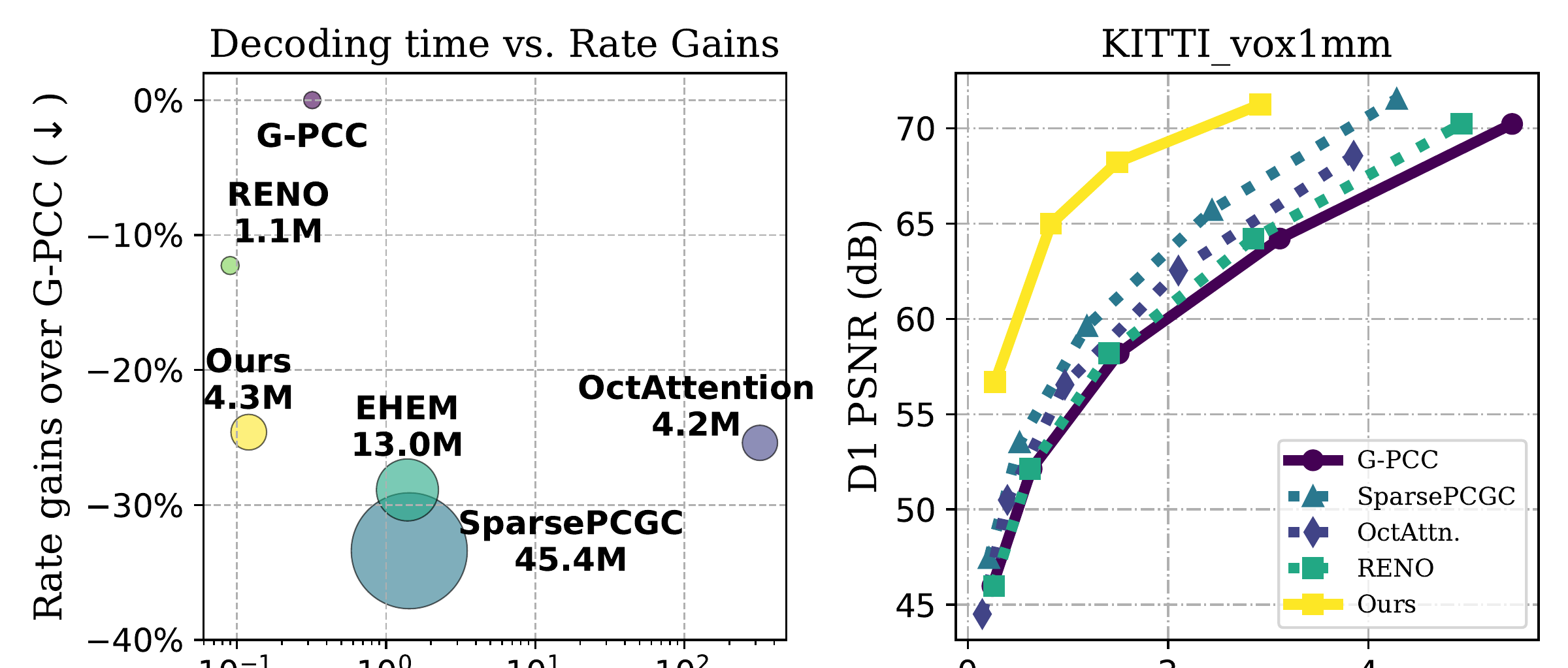
Left: Decoding efficiency and model footprint on SemanticKITTI, circle size indicates model size. Right: Rate-distortion curve on SemanticKITTI_vox1mm.
Generalization on Ford Dataset
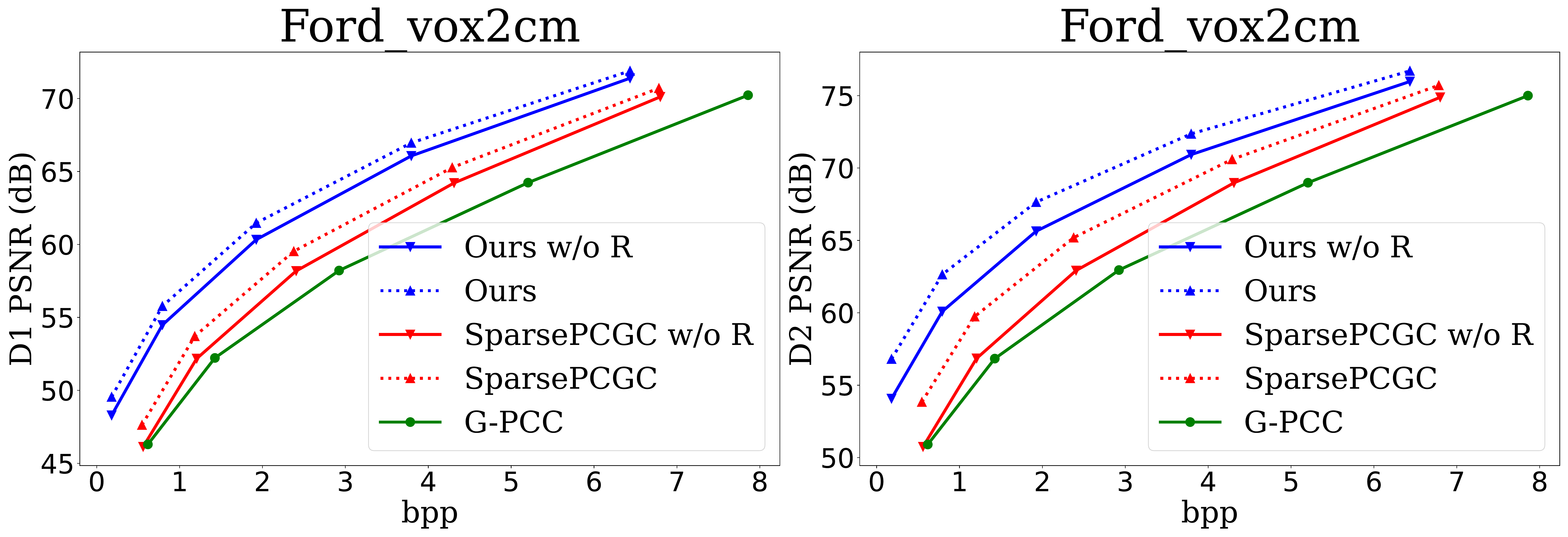
Generalization ability test on Ford Dataset. Our method demonstrates robustness and generalizes well to unseen LiDAR scenes.
Qualitative Results
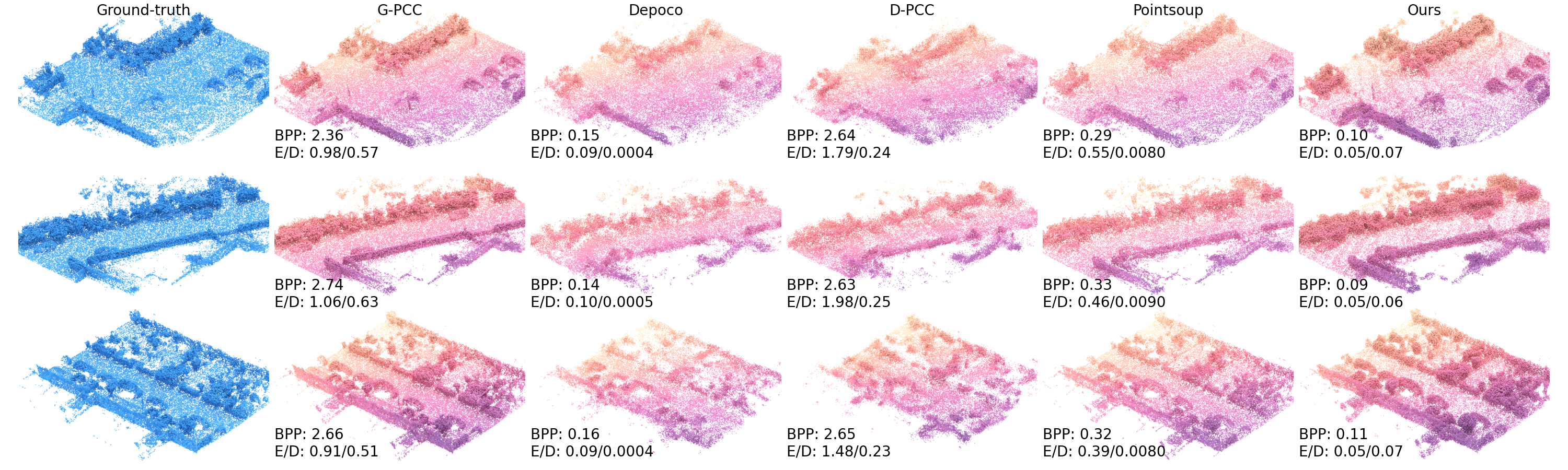
Qualitative results on the 40mILEN dataset. E/D denotes encoding and decoding time (in secs). Zoom in for details.
Citation
@inproceedings{zhang2026flatec,
  title     = {FLaTEC: Frequency-disentangled Latent Triplanes for Efficient Compression of LiDAR Point Clouds},
  author    = {Zhang, Xiaoge and Wu, Zijie and Feng, Mingtao and Geng, Zichen and Nasim, Mehwish and Anwar, Saeed and Mian, Ajmal},
  booktitle = {IEEE International Conference on Multimedia and Expo (ICME)},
  year      = {2026}
}
Acknowledgements
This work was supported by the Australian Research Council (ARC) under discovery grant project # 240101926. Professor Ajmal Mian was supported by ARC Fellowship Award funded by Australian Government under Project FT210100268.