PGMS: Pyramidal Gaussian Mixture Splatting for 3DGS Compression
- Xiaoge Zhang1
- Zijie Wu1
- Zichen Geng1
- Mehwish Nasim1
- Saeed Anwar1
- Ajmal Mian1
- 1The University of Western Australia
Abstract
3D Gaussian Splatting (3DGS) has become an established representation for real-time novel view synthesis. However, preserving fine geometric structures and appearance details typically requires millions of Gaussian primitives, resulting in substantial storage and transmission overhead. 3DGS compression has been extensively studied through attribute quantization, entropy coding, and lightweight reparameterization. However, existing methods often operate on a fixed backbone and therefore do not explicitly model the joint redundancy between geometry and appearance in the original dense Gaussian set.
To address this limitation, we propose Pyramidal Gaussian Mixture Splatting (PGMS), a plug-and-play 3DGS compression framework that reformulates dense Gaussian primitives into a rate-controllable pyramidal representation with scale-dependent attributes. Experiments on standard benchmarks show that our method delivers strong compression with high rendering fidelity and consistently outperforms state-of-the-art 3DGS compression methods.
Pipeline
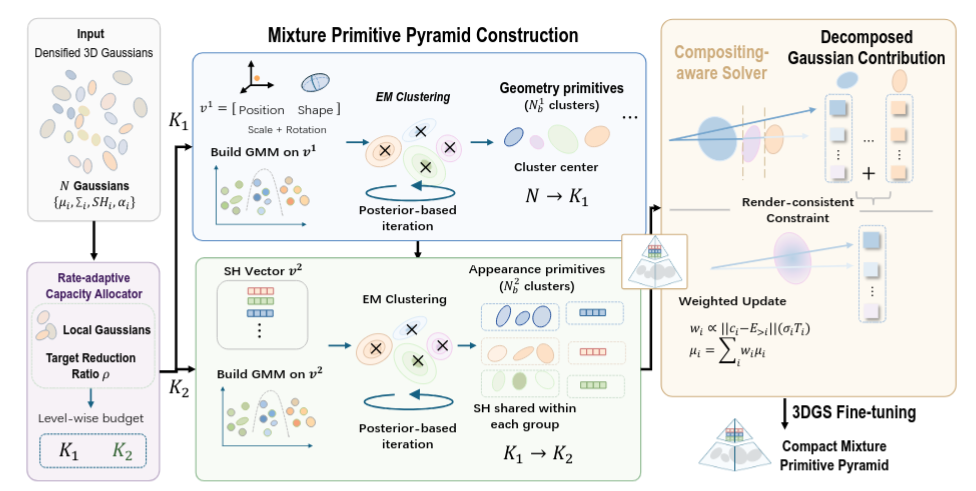
Given a set of densified Gaussians, PGMS adaptively learns a tiered budget for the mixture pyramid, constructs a Mixture Primitive Pyramid through level-wise clustering, and applies compositing-aware updates to preserve visual fidelity.
Results
Main Quantitative Results
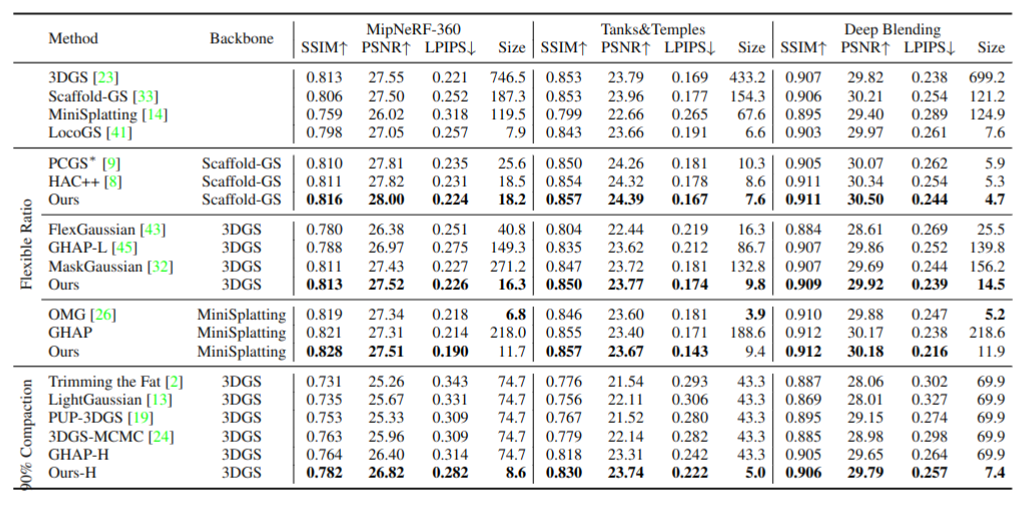
Comparison on MipNeRF-360, Tanks&Temples and Deep Blending with Size/Count metrics.
Qualitative Comparison
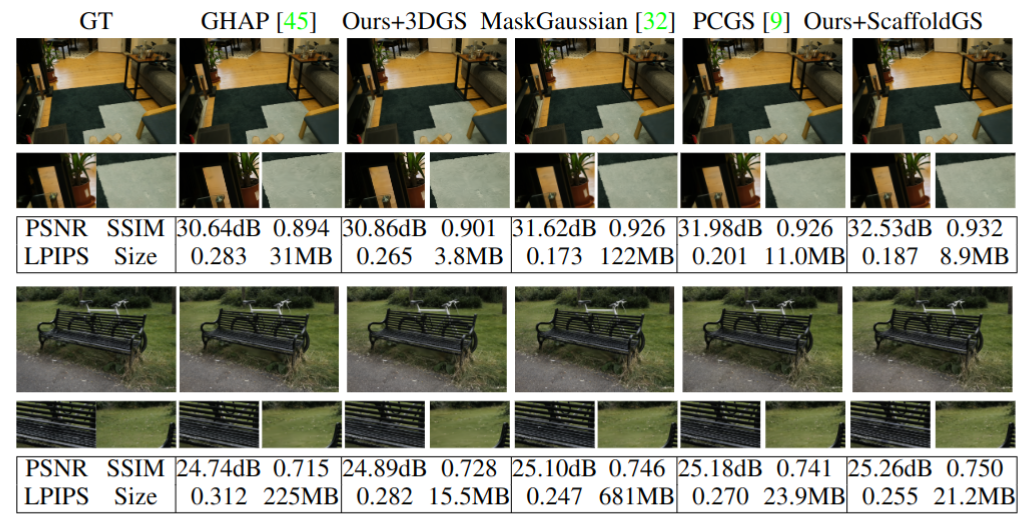
Qualitative comparison with GHAP, MaskGaussian, and PCGS.
Computational Efficiency
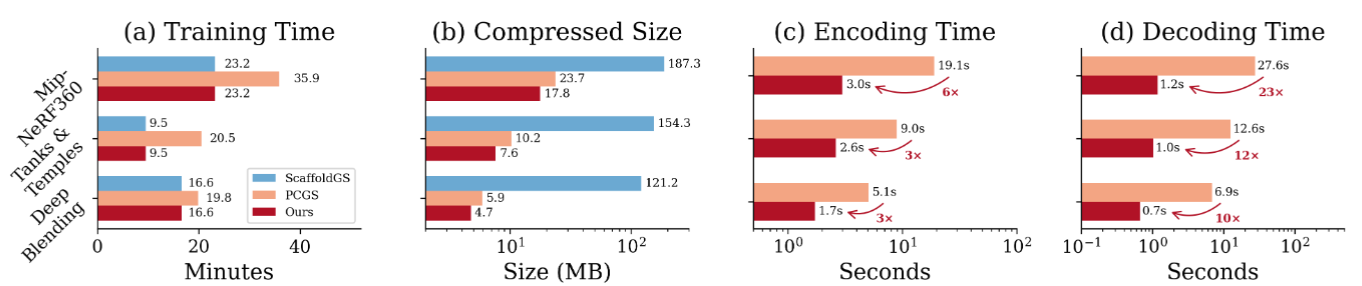
Complexity comparison across Scaffold-GS backbone on Mip-NeRF360, Tanks & Temples, and Deep Blending datasets.
Acknowledgements
This work was supported by the Australian Research Council (ARC) under discovery grant project # 240101926. Professor Ajmal Mian was supported by ARC Fellowship Award funded by Australian Government under Project FT210100268.